CELPIP® Speaking Task 5 sample: Choosing a Staff Wellness Program
Comparing and Persuading · Choose: 60 seconds · Preparation: 60 seconds · Response: 60 seconds · Published
Original practice questions in CELPIP® task formats, created independently by CELPIP Study.
Practice question
You sit on the wellness committee at a 40-person accounting firm in Burnaby. The committee has $2,000 to spend on one health program for staff from January to March. Most employees sit at desks all day, the office gets very busy in March, and the program should appeal to as many people as possible. Choose one of the two programs below.
Lunchtime Yoga and Stretching Classes
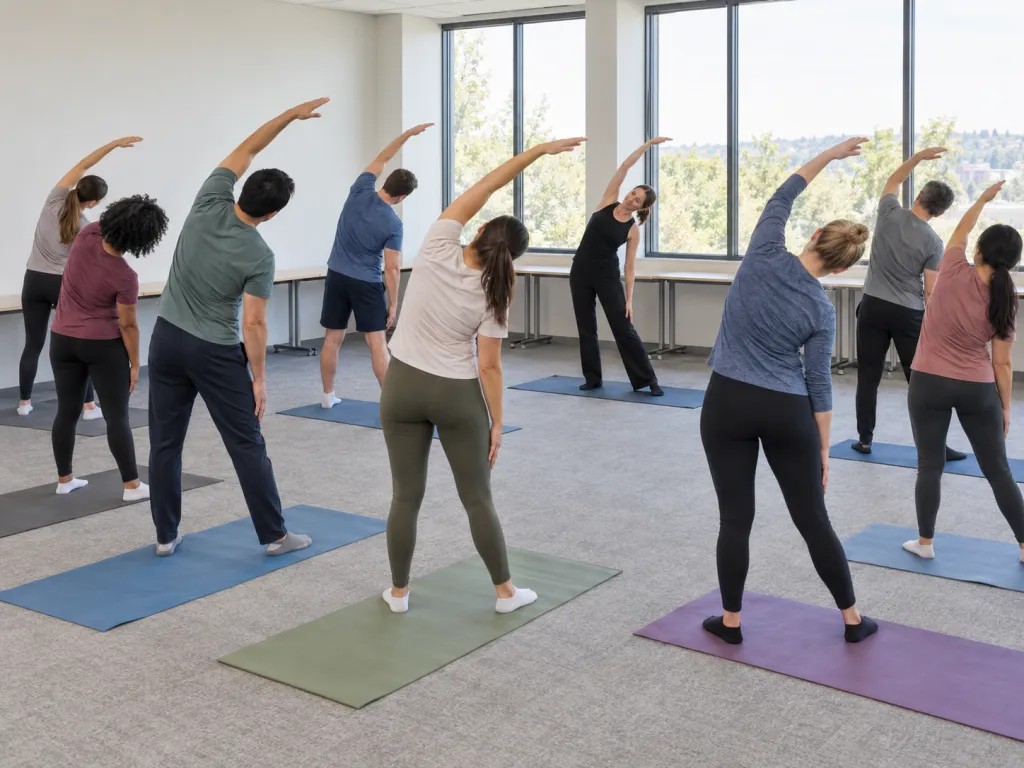
- Cost: $1,800 for 24 classes over twelve weeks
- Twice weekly in the boardroom, Tuesdays and Thursdays at noon
- Room fits a maximum of 15 people
- Certified instructor adjusts moves for all fitness levels
Team Step Challenge

- Cost: $1,400 for 40 basic step-counter bands and prizes
- Runs all twelve weeks, on each person's own schedule
- Everyone can take part, in teams of five
- No instructor; interest often drops after the first month
Your friend’s alternative
Healthy Lunch Delivery Fridays

- Cost: $1,950 for catered lunches every second Friday
- Six lunches between January and March
- Open to all 40 staff
- No physical activity; focuses on nutrition only
Your friend Jing, who also sits on the committee, thinks catered healthy lunches would be more popular with everyone. Persuade Jing that the program you chose would do more for your coworkers' health.
Model answers
These are transcripts of a model response, provided for comparison with your own recording.
The models choose Team Step Challenge before responding to the friend’s alternative.
Level 7 sample answer
136 words
Jing, I agree that everybody likes free food, and the lunches are open to all forty people. It's a nice idea. But I think the step challenge is better. First, our problem is that people sit at desks all day. The lunches don't have any exercise, so they don't help with that. With the step challenge, people walk more every day. Also, the lunches are only six times, every second Friday. The step challenge goes for all twelve weeks, and everyone can do it on their own time, so even in March when we're busy it still works. And it's cheaper. It costs fourteen hundred dollars, so we save six hundred dollars. I know sometimes people stop after the first month, but um, we can use the extra money for more prizes for keep them interested.
Why this answer is at level 7
This level 7 answer makes a clear choice and supports it with relevant facts about movement, scheduling, participation and cost. Compared with the higher-level answers, its explanations are simpler, its vocabulary is less varied, and an awkward grammatical ending weakens the delivery.
First, our problem is that people sit at desks all day.
— Content/Coherence: This identifies the central health concern and gives the argument a clear starting point. The higher-level answers develop the connection more fully by explaining how regular walking could change employees' daily routines.But I think the step challenge is better.
— Vocabulary: The preference is easy to understand, but “better” gives little detail about the advantage. The higher-level answers use more precise language about flexibility, inclusion and maintaining motivation.but um, we can use the extra money for more prizes for keep them interested.
— Listenability: The filler and the grammatical error in “for keep them interested” make this ending less smooth to say and follow. The higher-level answers express the same proposal through a more fluent, conversational question.everyone can do it on their own time, so even in March when we're busy it still works.
— Task Fulfillment: This directly addresses the busy March schedule and broad participation. A higher-level answer would make the flexibility more concrete, as the other answers do by describing a short walk that fits around work.
Level 9 sample answer
174 words
Jing, you're right that catered lunches would get the biggest cheer at first. Who's going to say no to free grain bowls? But I still think the step challenge would do more for our team, and I'd like to explain why.
The main issue we're trying to address is that almost everyone is glued to a desk all day. Lunches, however healthy, don't get anyone out of their chair. A step challenge does, and it's something people would do every day for twelve weeks, not just on six Fridays.
It's also far more flexible. Once March hits and we're all buried in work, nobody will have time for a sit-down lunch, but people can still squeeze in a walk around the block whenever it suits them. And since there are forty bands, nobody gets left out.
Finally, it costs fourteen hundred dollars instead of nearly two thousand. I know interest tends to fade after a month, so why don't we use the leftover six hundred for a mid-challenge prize to keep the momentum going?
Why this answer is at level 9
This level 9 answer develops a persuasive comparison with vivid vocabulary, clear organization and a practical response to declining interest. Compared with the top answer, some signposting is more explicit, and the proposed prize is less precisely timed; the claim that nobody will have time for lunch also overstates the evidence.
nobody will have time for a sit-down lunch
— Content/Coherence: This connects the comparison to March workload, but assumes too much about everyone's availability. A stronger argument would emphasize the challenge's scheduling flexibility without claiming that catered lunches would be impossible to attend.almost everyone is glued to a desk all day.
— Vocabulary: “Glued to a desk” makes the sedentary workday vivid and sounds natural in conversation. It improves on the simpler wording in level 7; the top answer extends this approach with imagery specifically connected to accounting work.But I still think the step challenge would do more for our team, and I'd like to explain why.
— Listenability: This clearly signals the position and prepares Jing for the explanation. It is easy to follow, although the top answer moves from its concession into its reasoning with less announcement and a more personal conversational rhythm.why don't we use the leftover six hundred for a mid-challenge prize to keep the momentum going?
— Task Fulfillment: This turns the remaining budget into a practical response to the stated risk of fading interest. The top answer strengthens that proposal by naming February, making the timing easier for Jing to picture.
Level 11 sample answer
190 words
Jing, I'll be the first to admit that catered lunches would be a crowd-pleaser; nothing fills a kitchen faster than free food. But when I picture what our coworkers' health actually needs, I keep landing on the step challenge.
The whole reason this committee exists is that most of us spend eight hours a day barely moving. A plate of salad, however well intentioned, does nothing to change that, whereas a step challenge nudges people out of their chairs every single day for twelve weeks, rather than on six scattered Fridays.
It also fits the reality of our calendar. By mid-March, when we're drowning in files, nobody's going to linger over a group lunch, but anyone can take a fifteen-minute walk whenever their schedule allows. With forty bands and teams of five, not a single person would be excluded.
And it comes in at fourteen hundred dollars, which leaves us roughly six hundred to work with. I'm well aware that enthusiasm often dips after the first month, so what if we set that money aside for a February team prize? That alone could keep people motivated through to the finish.
Why this answer is at level 11
This level 11 answer combines a sustained comparison, expressive vocabulary and a confident conversational voice. Its strongest feature is how it connects everyday movement, accounting workloads, inclusive participation and a February incentive into a persuasive recommendation tailored to Jing and the committee.
whereas a step challenge nudges people out of their chairs every single day for twelve weeks, rather than on six scattered Fridays.
— Content/Coherence: This integrates the health objective and the programs' different frequencies into a clear comparison. “Nudges” explains how the challenge encourages movement, although daily participation remains an expected benefit rather than a guaranteed result.By mid-March, when we're drowning in files,
— Vocabulary: The imagery fits an accounting firm's busy period and makes the scheduling argument feel specific to these coworkers. It shows greater contextual control than simply saying that March will be busy.But when I picture what our coworkers' health actually needs, I keep landing on the step challenge.
— Listenability: The sentence moves naturally from acknowledging the appeal of lunches to explaining a personal judgment. Its conversational phrasing gives the persuasion a clear voice without relying on a formal announcement of the argument.I'm well aware that enthusiasm often dips after the first month, so what if we set that money aside for a February team prize?
— Task Fulfillment: This acknowledges the chosen program's stated weakness and proposes a timely solution using the remaining budget. The collaborative question invites Jing into the decision, while a team prize fits the challenge's team structure.
What moves an answer from 7 to 9 to 11
These are model answers written to show each level. The labels are practice estimates, not examiner scores.
Make your chosen option clear and compare it with the friend’s alternative using the stated facts. Explain how those differences meet your needs and persuade the listener respectfully.
- Content/Coherence: Level 7 models communicate the main ideas; level 9 models develop relevant details with clear connections; level 11 models sustain precise, well-integrated development.
- Vocabulary: Compare adequate everyday wording with more varied, accurate choices at level 9 and flexible, precise expression at level 11.
- Listenability: Higher-level delivery needs clear pronunciation, rhythm, intonation and controlled pauses. Transcripts suggest phrasing and organisation, but cannot demonstrate these audio features; a recording is needed.
- Task Fulfillment: Compare how fully the response addresses the request, develops enough relevant detail and maintains an appropriate tone for the audience within the task limits.
Assess the criteria together. A longer answer or rarer words alone do not establish a higher level.
Answer this question and get your level
More Task 5 questions
- Choosing a Winter Sports League
- Booking a Family Camping Weekend
- Picking a Restaurant for a Club Anniversary
- Signing Up for a Winter Hobby Class
- Keeping Camping Gear Dry
- Cooling a Shared Apartment
All speaking Task 5 sample questions · Read the Task 5 guide