CELPIP® Speaking Task 8 sample: A Carrier With Accordion Folds
Describing an Unusual Situation · Preparation: 30 seconds · Response: 60 seconds · Published
Original practice questions in CELPIP® task formats, created independently by CELPIP Study.
Practice question
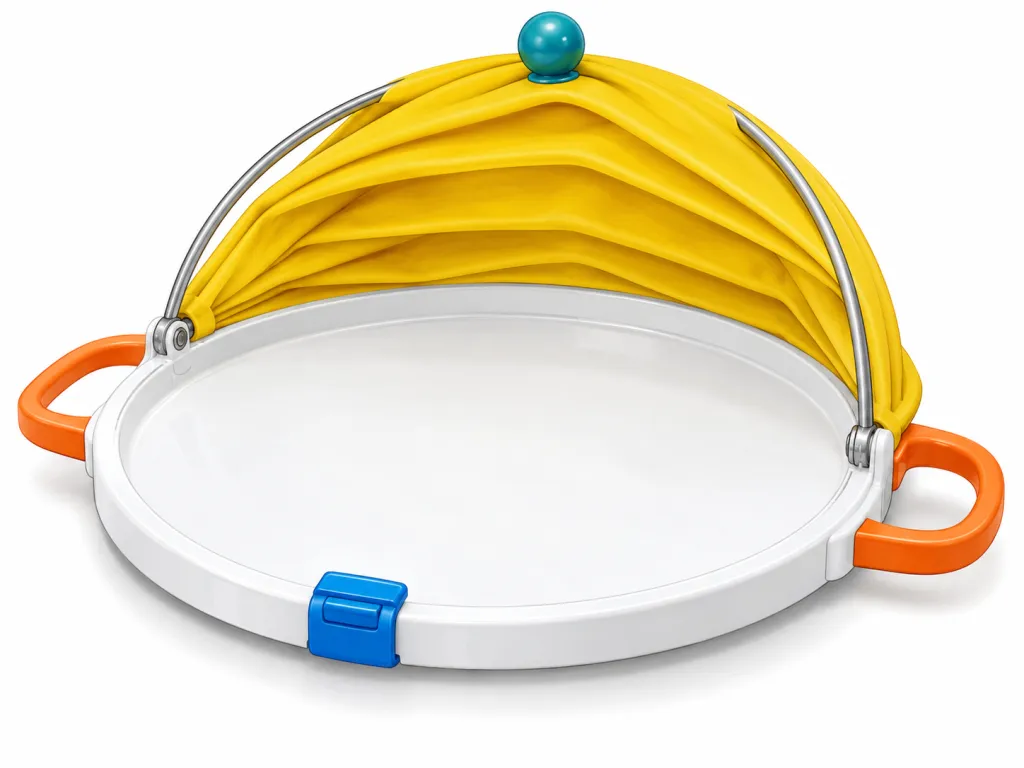
You are collecting equipment from a community centre in Winnipeg for tomorrow's office potluck. You find an unusual food carrier that could also serve as a platter, available to borrow. Call your coworker Kiran, who is organizing the meal. The serving table is small, and disposable dishes aren't allowed. Describe the object in detail in your own words and ask whether you should borrow it.
Model answers
These are transcripts of a model response, provided for comparison with your own recording.
Level 7 sample answer
120 words
Hi Kiran, I'm collecting equipment at the community centre in Winnipeg. There's a food carrier we can borrow for tomorrow's potluck. The bottom is a round white tray, about 50 centimetres across, with orange handles on both sides. Above it is a yellow cover with deep folds. The cover have two curved silver supports, and it folds toward the back. There's also a blue latch at the front and a teal knob on top. Um, it looks like a little tent for food. We could serve something directly on tray, so we wouldn't need disposable dishes for that food. But it's quite wide, and our serving table is small. Should I borrow it anyway? Thanks, I'll talk to you later.
Why this answer is at level 7
This level 7 answer gives Kiran a clear basic description, addresses the potluck constraints, and asks whether to borrow the carrier. Compared with the higher-level answers, its simpler vocabulary, grammatical slips, and less developed explanation of the cover limit its precision and polish.
Above it is a yellow cover with deep folds.
— Content/Coherence: Moving from the tray to the cover creates an easy spatial sequence. However, the description leaves the cover's shape less developed; the higher-level answers explain the dome it would form when extended.Um, it looks like a little tent for food.
— Vocabulary: The tent comparison gives Kiran a familiar visual reference. However, 'little tent' is broad; the higher-level answers use accordion folds, ribs, and a dome to describe the distinctive structure more precisely.The cover have two curved silver supports, and it folds toward the back.
— Listenability: The sentence is short and understandable, but 'The cover have' interrupts grammatical smoothness. The higher-level answers use accurate agreement and clearer descriptions of how the cover opens.We could serve something directly on tray, so we wouldn't need disposable dishes for that food.
— Task Fulfillment: This directly connects the carrier to the restriction on disposable dishes. The higher-level answers develop its combined transport and serving role more clearly and make the final borrowing decision more closely depend on the table-space trade-off.
Level 9 sample answer
149 words
Hi Kiran, I'm at the community centre picking up equipment, and there's an unusual carrier available for tomorrow's potluck. Could you help me decide whether to borrow it? The base is a white circular platter, 50 centimetres across, with an orange loop handle on each side. Over that sits a yellow silicone cover with accordion folds. Two curved silver ribs support it, and it folds backward to uncover the platter. There's a teal knob on the highest fold and a blue rectangular latch on the front rim. When fully raised, the cover would make a dome about 25 centimetres high. I imagine it could carry food and then serve as a reusable platter, which would fit the no-disposables rule. The sticking point is its width: on our small serving table, it could crowd out other dishes. Given that trade-off, should I borrow it? Thanks, I'll wait to hear. Bye!
Why this answer is at level 9
This level 9 answer combines precise visual details, a clear explanation of the cover's movement, and a practical borrowing question. It goes beyond level 7 in specificity and organization, while level 11 connects the object's construction, use, and effect on the table layout more fully.
Two curved silver ribs support it, and it folds backward to uncover the platter.
— Content/Coherence: The description explains how the parts function together, helping Kiran picture the serving surface becoming accessible. The level 11 answer develops that relationship further by identifying where the ribs are hinged.The base is a white circular platter, 50 centimetres across, with an orange loop handle on each side.
— Vocabulary: Words such as 'platter' and 'loop handle' distinguish the serving surface and handle shape more precisely than the level 7 wording. Level 11 adds similarly precise language for the mechanism, including 'hinged' and 'retract.'The sticking point is its width: on our small serving table, it could crowd out other dishes.
— Listenability: The conversational phrase 'The sticking point' clearly signals the move from description to concern. Level 11 makes that concern more explicit by explaining that folding away the cover would still leave the platter occupying substantial table space.Given that trade-off, should I borrow it?
— Task Fulfillment: The borrowing request follows directly from the reusable-platter benefit and the limited table space. Level 11 makes the choice more concrete by offering to leave it behind and explicitly recognizing Kiran's responsibility for the layout.
Level 11 sample answer
170 words
Kiran, I'm at the community centre collecting the potluck equipment, and I'd like your verdict on an unusual carrier we could borrow. Picture a white circular platter, 50 centimetres in diameter, fitted with orange loop handles on opposite sides. Its yellow silicone canopy resembles an accordion stretched over two curved silver ribs, which are hinged to the platter's edges. The canopy is partly folded backward, exposing the serving surface; fully extended, it would form a dome 25 centimetres high. A teal knob sits on its uppermost fold, while a blue rectangular latch is mounted on the front rim. Presumably, we'd close it for transport and retract the cover when serving. That would give us a reusable serving dish without having to transfer the food, which suits tomorrow's requirements. However, a half-metre platter would claim a substantial share of our small table, even with its cover folded away. Would the convenience justify that space, or should I leave it here? You're coordinating the layout, so I'll follow your lead. Thanks, bye.
Why this answer is at level 11
This level 11 answer integrates detailed visual description with a convincing explanation of transport, serving, and table space. Precise language, clearly marked inference, and a decision tailored to Kiran's organizing role make it the strongest and most fully developed answer in this set.
Presumably, we'd close it for transport and retract the cover when serving.
— Content/Coherence: This turns the preceding description into a practical sequence of use. 'Presumably' also marks the operation as an inference, keeping the explanation clear about what the speaker observes and what they conclude.Its yellow silicone canopy resembles an accordion stretched over two curved silver ribs, which are hinged to the platter's edges.
— Vocabulary: The accordion comparison supplies a recognizable shape, while 'canopy,' 'ribs,' and 'hinged' identify the structure and connections precisely. These details give Kiran a fuller picture of the unusual mechanism than the simpler tent comparison.Picture a white circular platter, 50 centimetres in diameter, fitted with orange loop handles on opposite sides.
— Listenability: The direct invitation 'Picture' suits a phone description. The sentence establishes the main shape before adding size and handle placement, giving the listener a clear framework for the more detailed cover description that follows.Would the convenience justify that space, or should I leave it here?
— Task Fulfillment: This asks for an actionable decision that weighs the carrier's convenience against its footprint. The surrounding explanation establishes its reusable serving role and explains why the small table remains a concern even with the cover folded away.
What moves an answer from 7 to 9 to 11
These are model answers written to show each level. The labels are practice estimates, not examiner scores.
Help the listener picture the unusual object through its shape, material, size and arrangement. Use comparisons and spatial language, then complete the requested interaction.
- Content/Coherence: Level 7 models communicate the main ideas; level 9 models develop relevant details with clear connections; level 11 models sustain precise, well-integrated development.
- Vocabulary: Compare adequate everyday wording with more varied, accurate choices at level 9 and flexible, precise expression at level 11.
- Listenability: Higher-level delivery needs clear pronunciation, rhythm, intonation and controlled pauses. Transcripts suggest phrasing and organisation, but cannot demonstrate these audio features; a recording is needed.
- Task Fulfillment: Compare how fully the response addresses the request, develops enough relevant detail and maintains an appropriate tone for the audience within the task limits.
Assess the criteria together. A longer answer or rarer words alone do not establish a higher level.
Answer this question and get your level
More Task 8 questions
- The Hourglass Vegetable Gadget
- A Pear-Shaped Scrap Press
- The Suspended Teapot
- The Recycling Flower
- The Floating Leaf Scoop
- The Envelope Sealing Bridge
All speaking Task 8 sample questions · Read the Task 8 guide