CELPIP® Speaking Task 8 sample: The Envelope Sealing Bridge
Describing an Unusual Situation · Preparation: 30 seconds · Response: 60 seconds · Published
Original practice questions in CELPIP® task formats, created independently by CELPIP Study.
Practice question
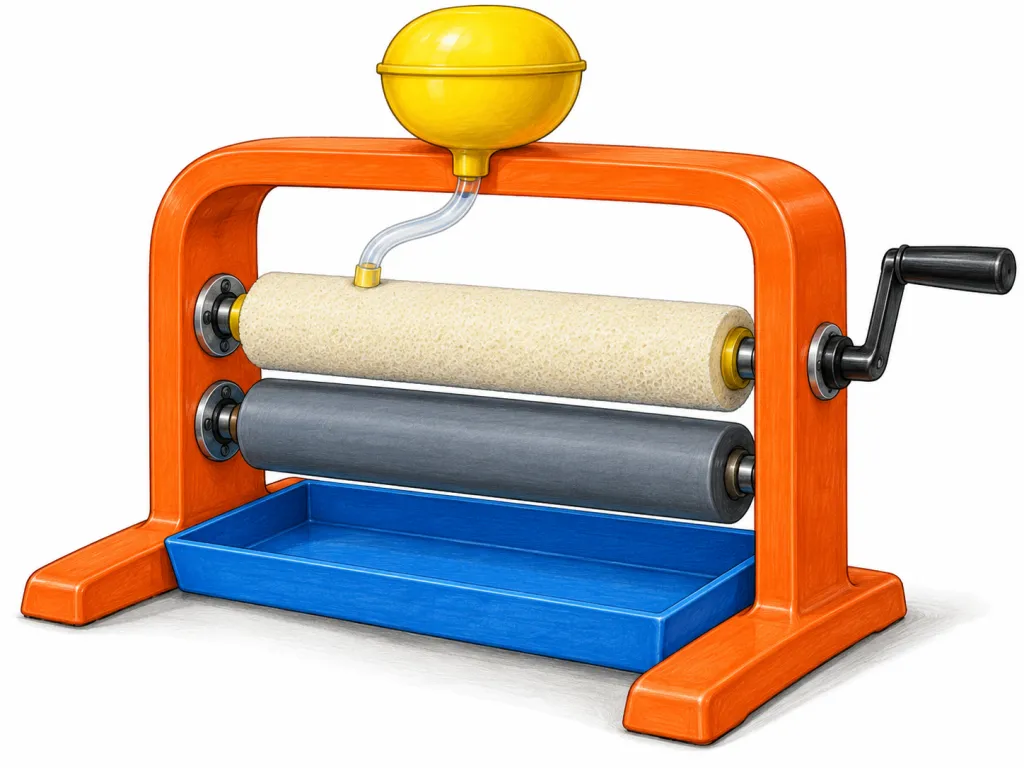
You are at a postal supplies demonstration in Guelph. Camille, your community newsletter editor, needs help mailing 80 newsletters by Friday. You see an unusual envelope-sealing tool for $30, but only $35 remains for supplies. Call Camille, describe the tool in detail in your own words, and ask whether to buy it or keep sealing envelopes by hand.
Model answers
These are transcripts of a model response, provided for comparison with your own recording.
Level 7 sample answer
126 words
Hi Camille, I'm at the postal supplies demonstration in Guelph. There's a strange tool here that might help with our 80 newsletters. It looks like a little orange plastic bridge on two flat foot. A blue rectangular tray goes underneath two rollers. The top roller has cream sponge, and the bottom one is grey rubber. There's a yellow half-ball on top, connected to the upper roller by a clear tube. A black crank sticks out on the right. It's 35 centimetres long, 18 wide and 25 tall. Um, I think you turn the crank and feed envelopes through machine to seal them. It costs $30, leaving only $5 for supplies. Should I buy it to help finish by Friday, or keep sealing by hand? Thanks, bye.
Why this answer is at level 7
This level 7 answer gives Camille a recognizable description and completes the buying question. However, it reads mainly as a list of features, with some grammatical slips and a brief explanation of how the tool works; the higher-level answers connect the parts and the purchasing decision more fully.
A blue rectangular tray goes underneath two rollers.
— Content/Coherence: This establishes a useful spatial relationship, but the description moves quickly to the next feature. The higher-level answers explain how the rollers sit within the frame, helping Camille assemble a clearer mental picture.There's a yellow half-ball on top, connected to the upper roller by a clear tube.
— Vocabulary: The familiar shape comparison makes the unusual part easy to imagine. However, calling it a half-ball describes only its appearance; the higher-level answers identify it as a reservoir, making its likely purpose clearer.It looks like a little orange plastic bridge on two flat foot.
— Listenability: The bridge comparison gives the listener an accessible starting point. The grammatical slip in “two flat foot” interrupts an otherwise straightforward sentence; the higher-level answers use “two flat feet” and maintain smoother sentence control.It costs $30, leaving only $5 for supplies.
— Task Fulfillment: This clearly communicates the financial consequence of buying the tool. The higher-level answers connect that consequence more closely to finishing the mailing or to uncertainty about whether the tool will actually save work.
Level 9 sample answer
158 words
Hi Camille, I'm at the postal supplies demonstration in Guelph, looking at something that might speed up our newsletter mailing. Picture an orange plastic bridge with two flat feet and a blue rectangular tray running underneath. Above the tray are two horizontal rollers, attached at both ends to the frame. The upper one is covered in cream sponge; the lower one is grey rubber. There's a yellow reservoir shaped like half a ball on top, with a clear curved tube leading to the sponge roller. A black crank sticks out on the right. I suspect it moistens and presses envelope flaps as you turn the crank. It's fairly compact: 35 centimetres long, 18 wide and 25 tall. With 80 newsletters due by Friday, it could save time, but the $30 price would leave just $5 for other supplies. I'm on the fence. Should I buy it, or should we keep sealing envelopes by hand? Thanks, Camille. Talk soon.
Why this answer is at level 9
This level 9 answer combines a clearly organized description, controlled sentences, and a practical explanation of the budget tradeoff. Compared with the level 11 answer, its reasoning stops largely at possible time savings and cost, without exploring what could prevent the tool from helping.
Above the tray are two horizontal rollers, attached at both ends to the frame.
— Content/Coherence: The description builds outward from the tray and explains how the rollers connect to the structure. This is more coherent than a simple feature list; the top answer further clarifies the rollers’ relationship by explicitly placing one above the other.There's a yellow reservoir shaped like half a ball on top
— Vocabulary: “Reservoir” identifies the component’s likely function, while the shape comparison keeps the description accessible. The top answer uses “hemispherical reservoir” to express the same shape and component type more compactly.It's fairly compact: 35 centimetres long, 18 wide and 25 tall.
— Listenability: The introductory phrase gives the measurements a clear purpose, and the parallel wording makes them easy to follow. The top answer more explicitly links the operating description through an action sequence, showing how turning, moistening, and pressing fit together.it could save time, but the $30 price would leave just $5 for other supplies.
— Task Fulfillment: This directly balances a benefit against the limited supplies budget, giving Camille a useful basis for choosing. The top answer develops the decision further by considering envelope compatibility and adjustments that could cancel the expected time savings.
Level 11 sample answer
173 words
Hi Camille, there's an unusual envelope-sealing tool at the postal supplies demonstration in Guelph that might help us get those 80 newsletters mailed by Friday. Imagine an orange plastic arch standing on two flat feet, with a rectangular blue tray passing between them. Two horizontal rollers are mounted across the frame, one above the other: cream sponge on top and grey rubber below. A yellow hemispherical reservoir crowns the arch, and a transparent curved tube connects it to the sponge roller. On the right, a black crank lines up with that upper roller. Presumably, turning it draws an envelope through while the sponge moistens the flap and the rollers press it shut. The whole unit measures 35 centimetres long, 18 wide and 25 tall. Although it could save repetitive work, we'd be spending $30 of our remaining $35 before knowing whether it handles our envelopes well. If it needs constant adjustment, the time savings could disappear. Would you buy it for this mailing, or stick with sealing by hand? Thanks, Camille. Talk soon.
Why this answer is at level 11
This level 11 answer combines precise spatial description with a connected explanation of the tool’s likely operation. It also gives Camille a stronger basis for deciding by weighing the limited budget against uncertain performance and possible adjustment time.
If it needs constant adjustment, the time savings could disappear.
— Content/Coherence: This follows logically from the concern about whether the tool handles their envelopes well. It develops the purchasing argument beyond price by explaining how a practical problem could undermine the main benefit.A yellow hemispherical reservoir crowns the arch
— Vocabulary: “Hemispherical reservoir” precisely conveys both shape and component type, while “crowns the arch” locates it economically. The wording adds detail that helps Camille picture this particular tool.one above the other: cream sponge on top and grey rubber below.
— Listenability: The paired directions and materials make the roller arrangement easy to track. This compact, parallel structure helps the listener retain several details without having to reconstruct their positions from separate statements.Would you buy it for this mailing, or stick with sealing by hand?
— Task Fulfillment: The closing question explicitly presents both requested options and ties the purchase to the current mailing. Coming after the budget and performance concerns, it invites Camille to make a concrete, informed decision.
What moves an answer from 7 to 9 to 11
These are model answers written to show each level. The labels are practice estimates, not examiner scores.
Help the listener picture the unusual object through its shape, material, size and arrangement. Use comparisons and spatial language, then complete the requested interaction.
- Content/Coherence: Level 7 models communicate the main ideas; level 9 models develop relevant details with clear connections; level 11 models sustain precise, well-integrated development.
- Vocabulary: Compare adequate everyday wording with more varied, accurate choices at level 9 and flexible, precise expression at level 11.
- Listenability: Higher-level delivery needs clear pronunciation, rhythm, intonation and controlled pauses. Transcripts suggest phrasing and organisation, but cannot demonstrate these audio features; a recording is needed.
- Task Fulfillment: Compare how fully the response addresses the request, develops enough relevant detail and maintains an appropriate tone for the audience within the task limits.
Assess the criteria together. A longer answer or rarer words alone do not establish a higher level.
Answer this question and get your level
More Task 8 questions
- The Curved Permit Display
- The Six-Armed Loop Tree
- The Boot-Shaped Seed Sorter
- The Fish-Shaped Raffle Mixer
- The S-Shaped Photo Viewer
- The Long-Necked Printing Press
All speaking Task 8 sample questions · Read the Task 8 guide