CELPIP® Speaking Task 8 sample: The S-Shaped Photo Viewer
Describing an Unusual Situation · Preparation: 30 seconds · Response: 60 seconds · Published
Original practice questions in CELPIP® task formats, created independently by CELPIP Study.
Practice question
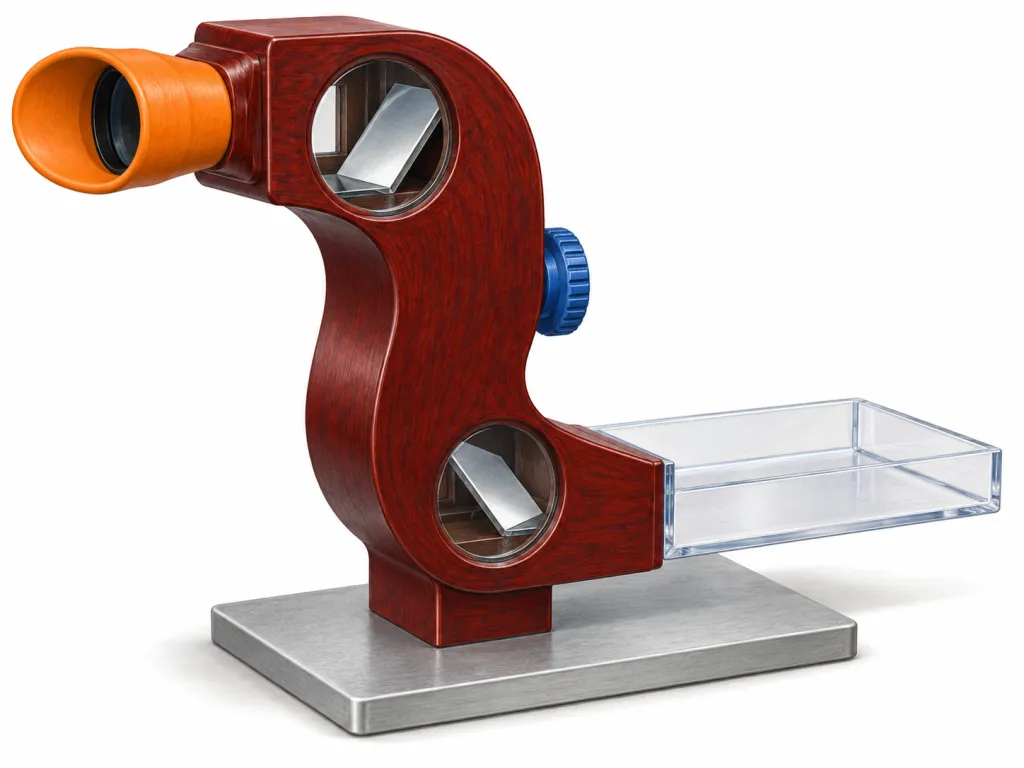
You are preparing a volunteer-run local history exhibition at a community hall in Sudbury. A club member offers an unusual photo viewer. Original photographs must stay flat, and visitors need to use the display while seated. Call Wen, your club’s archivist, who is choosing the display equipment. Describe the viewer carefully in your own words and ask whether you should accept it for the exhibition.
Model answers
These are transcripts of a model response, provided for comparison with your own recording.
Level 7 sample answer
127 words
Hi Wen, I'm at the community hall in Sudbury, getting our history exhibition ready. A club member offered us a strange photo viewer. It's about 45 centimetres tall and shaped like a thick red letter S. The wooden body stands on a flat grey metal base. An orange eyepiece sticks out at the top left, and a clear tray comes out at the bottom right. Also, there's two round windows showing silver mirrors inside. A blue wheel is attached halfway down the right side. Um, I think you put a photo in tray and look through the top. It could keep our originals flat, but the eyepiece might be too high for seated visitors. Should I accept it for the exhibition? Thanks, I'll wait for your opinion.
Why this answer is at level 7
This answer gives Wen a recognizable description and addresses both exhibition requirements. Compared with the higher-level answers, its details are more list-like, its wording is less precise, and a few grammatical slips interrupt the flow.
The wooden body stands on a flat grey metal base.
— Content/Coherence: This establishes the viewer's support clearly, but the description then lists individual features. A higher-level answer would connect the bends, eyepiece, tray and mirrors more explicitly so Wen could picture their arrangement.It's about 45 centimetres tall and shaped like a thick red letter S.
— Vocabulary: The familiar letter comparison communicates the unusual shape effectively. Higher-level wording would add precision about the upright housing and the directions of its bends.Also, there's two round windows showing silver mirrors inside.
— Listenability: The feature is understandable, but the agreement error in “there's two” slightly interrupts the flow. A higher-level answer would use smoother grammar and explain where the windows sit.It could keep our originals flat, but the eyepiece might be too high for seated visitors.
— Task Fulfillment: This directly connects the viewer to both requirements, making the description relevant to Wen's decision. A higher-level answer would turn the seating concern into a practical check before acceptance.
Level 9 sample answer
156 words
Hi Wen, I'm preparing the Sudbury history exhibition, and a club member has offered a photo viewer. You're choosing our display equipment, so could you help me decide? The dark red wooden body curves like an upright S, roughly 45 centimetres high and 30 wide overall. It stands on a broad grey rectangular metal base. An orange oval eyepiece projects from the upper left end, while an empty clear acrylic tray extends from the lower right end above the base. Two round windows reveal angled silver mirrors, one at each bend. There's also a blue ridged wheel on the right, halfway down. I imagine the mirrors let you view a photograph lying flat in the tray, and the wheel might adjust the focus. That sounds promising for our originals. However, we'd need to check whether seated visitors could reach the eyepiece comfortably. Should I accept it for the exhibition? Thanks, let me know what you think.
Why this answer is at level 9
This answer presents a clear spatial description, uses specific vocabulary, and explains why the viewer might suit the exhibition. Compared with the strongest answer, the shape is less fully mapped out and the acceptance request is less closely tied to a practical height check.
An orange oval eyepiece projects from the upper left end,
— Content/Coherence: Locating the eyepiece prepares Wen to understand its relationship to the lower tray. The strongest answer also explains how the housing's bends extend in opposite directions, giving the description a clearer overall structure.Two round windows reveal angled silver mirrors, one at each bend.
— Vocabulary: “Reveal” and “angled” describe visible features precisely, while the final phrase locates them efficiently. The strongest answer extends this precision with terms such as “inspection windows” and a clearer explanation of how the mirrors redirect the image.That sounds promising for our originals.
— Listenability: This short sentence gives the listener a clear transition from the proposed mechanism to its benefit. The strongest answer connects that benefit and the seating concern more tightly within a single contrasting sentence.However, we'd need to check whether seated visitors could reach the eyepiece comfortably.
— Task Fulfillment: This identifies the relevant accessibility check instead of assuming the viewer will work. The strongest answer specifies checking the height at the display table and makes that check a condition of the acceptance recommendation.
Level 11 sample answer
173 words
Hi Wen, I'm at the Sudbury community hall, considering a photo viewer that a club member has offered for our exhibition. Since you're selecting the equipment, I'd appreciate your assessment. It's approximately 45 centimetres high and 30 wide overall. The dark red wooden housing resembles a thick upright S: its upper bend extends left, while the lower bend curves right over a broad, light grey rectangular metal base. An orange oval eyepiece projects horizontally from the upper end. Below, an empty transparent acrylic tray extends from the lower end, leaving a flat surface for a photograph. Two circular inspection windows expose slanted silver mirrors at the bends, and a blue ribbed wheel sits halfway down the right side. Presumably, the mirrors redirect the image towards the eyepiece; the wheel may control focus. That arrangement could keep our originals flat, although the viewing height could be a sticking point for seated visitors. Would you recommend accepting it, provided we first check the eyepiece height at the display table? I'll wait for your decision. Thanks!
Why this answer is at level 11
This answer combines a precise spatial description with a clear explanation of the viewer's possible operation. Its strength is the way it distinguishes observation from inference and turns the exhibition requirements into a concrete, conditional request for Wen's decision.
its upper bend extends left, while the lower bend curves right over a broad, light grey rectangular metal base.
— Content/Coherence: This maps the unusual housing in a connected sequence, helping Wen visualize the opposing bends and their relationship to the base. It gives the later descriptions of the eyepiece and tray a clear spatial framework.Two circular inspection windows expose slanted silver mirrors at the bends,
— Vocabulary: The specific nouns and descriptive verbs distinguish the windows from the mirrors visible through them. The wording communicates shape, angle and location efficiently without relying on vague references.Presumably, the mirrors redirect the image towards the eyepiece; the wheel may control focus.
— Listenability: The paired clauses explain the proposed functions in a compact, easy-to-follow sequence. “Presumably” and “may” also make it clear that these functions are inferred rather than confirmed.Would you recommend accepting it, provided we first check the eyepiece height at the display table?
— Task Fulfillment: The request gives Wen a concrete decision to make and connects acceptance to the unresolved seating requirement. Mentioning the display table makes the proposed check relevant to the viewer's actual exhibition setup.
What moves an answer from 7 to 9 to 11
These are model answers written to show each level. The labels are practice estimates, not examiner scores.
Help the listener picture the unusual object through its shape, material, size and arrangement. Use comparisons and spatial language, then complete the requested interaction.
- Content/Coherence: Level 7 models communicate the main ideas; level 9 models develop relevant details with clear connections; level 11 models sustain precise, well-integrated development.
- Vocabulary: Compare adequate everyday wording with more varied, accurate choices at level 9 and flexible, precise expression at level 11.
- Listenability: Higher-level delivery needs clear pronunciation, rhythm, intonation and controlled pauses. Transcripts suggest phrasing and organisation, but cannot demonstrate these audio features; a recording is needed.
- Task Fulfillment: Compare how fully the response addresses the request, develops enough relevant detail and maintains an appropriate tone for the audience within the task limits.
Assess the criteria together. A longer answer or rarer words alone do not establish a higher level.
Answer this question and get your level
More Task 8 questions
- The Long-Necked Printing Press
- The Rocking Yarn Winder
- The Wrong Box in Whitehorse
- A Rolling Pin With Extras
- The Rolling Laundry Rack
- A Watering Can for the Birds
All speaking Task 8 sample questions · Read the Task 8 guide