CELPIP® Speaking Task 8 sample: The Rocking Yarn Winder
Describing an Unusual Situation · Preparation: 30 seconds · Response: 60 seconds · Published
Original practice questions in CELPIP® task formats, created independently by CELPIP Study.
Practice question
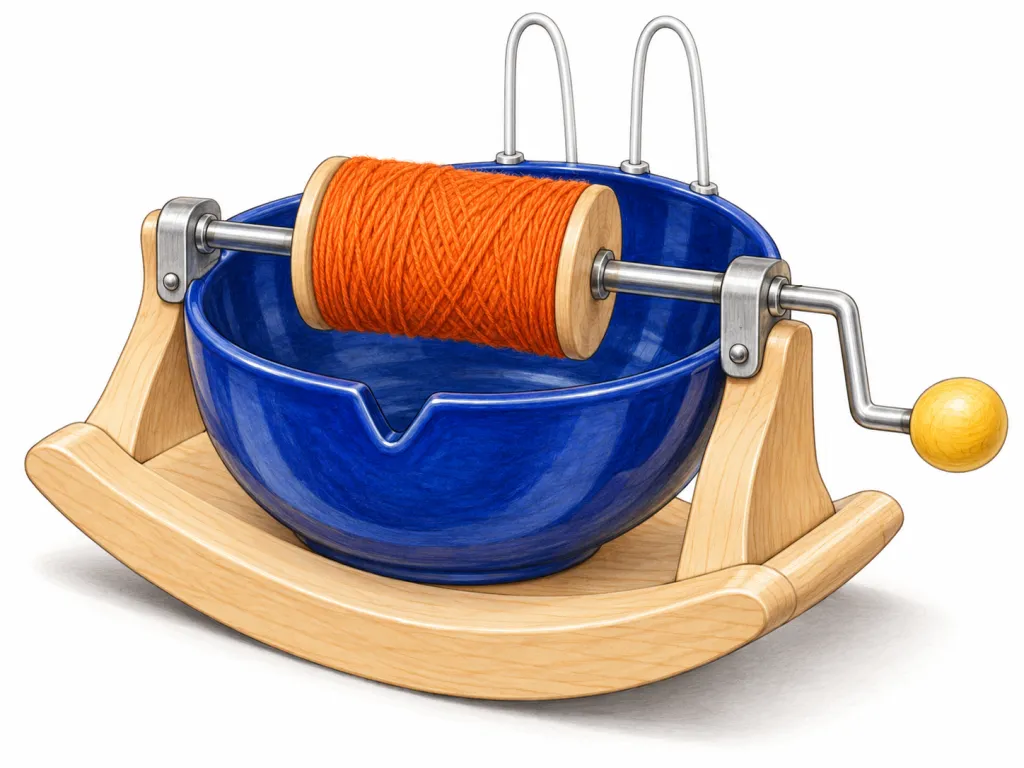
You are helping at a donation event in a Thunder Bay community centre when someone offers an unusual yarn-winding device to your knitting circle. Call your friend Sigrid, who runs the circle. Beginners will share one small table at the next meeting. Describe the object in detail in your own words and ask whether you should accept it, considering its size and curved base.
Model answers
These are transcripts of a model response, provided for comparison with your own recording.
Level 7 sample answer
126 words
Hi Sigrid, I'm helping at the donation event in Thunder Bay, and someone offered our knitting circle a strange yarn winder. It's about 30 centimetres wide and looks like a deep blue ceramic bowl. Underneath, a pale wooden base curves like a rocking chair. A silver bar crosses the top, with a wide orange spool in middle. On the right, there's an L-shaped handle with a round yellow wooden knob. Also, two white wire loops stand at the back, and there's a little triangular cut in the front edge. Um, I think the yarn goes through the loops onto the spool. It look useful, but it might rock on our small shared table. Should I accept it for the circle? Thanks, I'll wait for your answer.
Why this answer is at level 7
This level 7 answer gives Sigrid a recognizable description and clearly asks whether to accept the winder. Compared with the higher-level answers, it relies on simpler labels and list-like connections, contains grammatical slips, and leaves the beginners’ needs unstated.
Also, two white wire loops stand at the back,
— Content/Coherence: The location helps Sigrid picture the object, but “Also” makes this feel like another item on a checklist. The higher-level answers connect the rear loops and front notch more smoothly within the description.A silver bar crosses the top,
— Vocabulary: The wording communicates the basic appearance clearly. The higher-level answers use “spindle” and “rim” to identify the component and its position more precisely.It look useful, but it might rock on our small shared table.
— Listenability: The practical concern is easy to follow, but “It look” interrupts otherwise understandable phrasing. The higher-level answers maintain grammatical control while explaining how the curved base could affect the shared table.Should I accept it for the circle?
— Task Fulfillment: This directly asks Sigrid for the required decision. However, the answer never explicitly considers beginners, and it gives the width without explaining its effect on table space. The higher-level answers address those meeting conditions more fully.
Level 9 sample answer
158 words
Hi Sigrid, have you got a moment? Someone at the community centre donation event in Thunder Bay has offered a yarn winder to our knitting circle. It looks unusual enough that I wanted to check with you. Picture a deep cobalt-blue ceramic bowl, roughly 30 centimetres wide and 25 high, mounted on a pale wooden rocker. A silver spindle crosses the rim and holds a wide orange spool in the centre. On the right, an L-shaped silver crank ends in a yellow wooden knob. Two tall white wire loops rise from the back, while a triangular notch interrupts the front rim. I'm guessing the loops and notch guide the yarn as you turn the crank. That could be handy for beginners, but the curved base might make it wobble while people share our one small table. Since you're running the circle, should I accept it, or would it be more trouble than it's worth? Thanks, let me know.
Why this answer is at level 9
This level 9 answer combines precise description, natural conversational framing, and a clear concern about beginners sharing the table. Compared with level 11, it leaves the connection between the object’s dimensions and limited table space less explicit.
Two tall white wire loops rise from the back, while a triangular notch interrupts the front rim.
— Content/Coherence: The linked rear and front details create a coherent spatial picture rather than a simple list. The top answer develops the physical reasoning further by explaining the rocker’s curved underside as soon as it introduces the base.On the right, an L-shaped silver crank ends in a yellow wooden knob.
— Vocabulary: “Crank” names the turning mechanism precisely, while shape, material, colour, and position make it easy to visualize. The top answer adds how this component connects to the spindle, making the mechanical description more integrated.Picture a deep cobalt-blue ceramic bowl, roughly 30 centimetres wide and 25 high, mounted on a pale wooden rocker.
— Listenability: “Picture” invites Sigrid to visualize the device, and the sentence groups its main features into a manageable description. The top answer gives the base’s stability concern a separate sentence, allowing that important implication more emphasis.That could be handy for beginners, but the curved base might make it wobble while people share our one small table.
— Task Fulfillment: This explicitly balances usefulness for beginners against instability at the shared table. The top answer also identifies the device’s footprint as a separate concern, connecting both size and base shape to the acceptance decision.
Level 11 sample answer
177 words
Hi Sigrid, I'm calling from the donation event at the Thunder Bay community centre. We've been offered a yarn-winding device for the knitting circle, and I'd like your judgement before accepting it for our next meeting. It's approximately 30 centimetres wide and 25 high: a deep cobalt-blue ceramic bowl mounted on a smooth, pale wooden rocker. The rocker's underside curves from left to right, which immediately raises a question about stability. A horizontal silver spindle bridges the bowl's rim, carrying a wide orange spool at its centre. On the right, it extends into an L-shaped crank with a round yellow wooden knob. Two tall white wire loops rise side by side from the rear rim, and there's a triangular notch at the front. Presumably, those openings guide the yarn while the crank turns the spool. Although beginners might appreciate a winding tool, its footprint and rocking base could complicate sharing our one small table. Would you like me to accept it for the circle, given those trade-offs? I'll leave it pending until I hear from you. Thanks!
Why this answer is at level 11
This level 11 answer integrates detailed spatial description with practical judgement about accepting the donation. Precise vocabulary, controlled phrasing, and explicit attention to both footprint and stability make its recommendation request especially well supported.
The rocker's underside curves from left to right, which immediately raises a question about stability.
— Content/Coherence: The answer connects a visible feature directly to its practical consequence. Introducing stability here gives the later concern about the shared table a clear foundation.A horizontal silver spindle bridges the bowl's rim, carrying a wide orange spool at its centre.
— Vocabulary: “Horizontal,” “spindle,” “bridges,” and “rim” describe orientation, component, and placement precisely. The sentence also explains how the spool sits within the assembly, helping Sigrid construct a connected mental picture.Although beginners might appreciate a winding tool, its footprint and rocking base could complicate sharing our one small table.
— Task Fulfillment: This brings the prompt’s practical constraints together: beginners’ possible benefit, limited table space, and the curved base. “Footprint” makes the size concern explicit rather than leaving Sigrid to infer it from the measurements.Would you like me to accept it for the circle, given those trade-offs?
— Listenability: The direct question gives the detailed description a clear conversational destination. “Those trade-offs” concisely gathers the benefits and concerns already explained, so the listener can focus on the decision.
What moves an answer from 7 to 9 to 11
These are model answers written to show each level. The labels are practice estimates, not examiner scores.
Help the listener picture the unusual object through its shape, material, size and arrangement. Use comparisons and spatial language, then complete the requested interaction.
- Content/Coherence: Level 7 models communicate the main ideas; level 9 models develop relevant details with clear connections; level 11 models sustain precise, well-integrated development.
- Vocabulary: Compare adequate everyday wording with more varied, accurate choices at level 9 and flexible, precise expression at level 11.
- Listenability: Higher-level delivery needs clear pronunciation, rhythm, intonation and controlled pauses. Transcripts suggest phrasing and organisation, but cannot demonstrate these audio features; a recording is needed.
- Task Fulfillment: Compare how fully the response addresses the request, develops enough relevant detail and maintains an appropriate tone for the audience within the task limits.
Assess the criteria together. A longer answer or rarer words alone do not establish a higher level.
Answer this question and get your level
More Task 8 questions
- The Wrong Box in Whitehorse
- A Rolling Pin With Extras
- The Rolling Laundry Rack
- A Watering Can for the Birds
- The Yellow Leash Gadget
- The Spiral Party Stand
All speaking Task 8 sample questions · Read the Task 8 guide