CELPIP® Speaking Task 4 sample: Shared Rental Yard Fence Repairs
Making Predictions · Preparation: 30 seconds · Response: 60 seconds · Published
Original practice questions in CELPIP® task formats, created independently by CELPIP Study.
Practice question
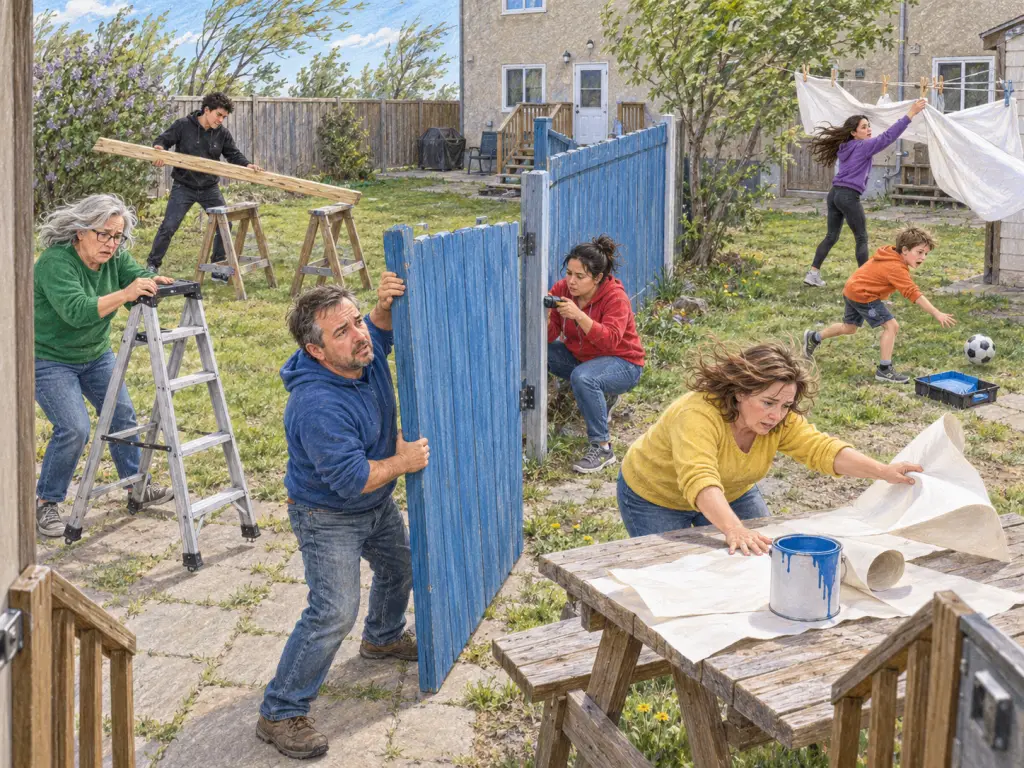
Predict the most likely developments in this shared yard over the next few minutes. Give reasons based on the people, weather and objects shown. You have 30 seconds to prepare and 60 seconds to speak.
Model answers
These are transcripts of a model response, provided for comparison with your own recording.
Level 7 sample answer
123 words
The boy will probably stop the ball before it reaches the paint tray because he's already chasing it. The girl will likely pull the sheet off the line quickly, since it's flapping towards the wet fence. Um, the woman at the table will probably catch the paper and keep it away from the open paint can. Étienne will continue holding the loose panel while Gabriela works on the hinge. He looks worried, so she might ask him to keep it steady. On the left, the woman will probably move the ladder because one foot isn't on the paving. She'll check it before she climb. The young man will likely lower the plank onto the two trestles, which should make holding it more easy.
Why this answer is at level 7
This level 7 example makes clear, relevant predictions about the yard and gives simple reasons. Repeated sentence patterns, occasional grammar problems and limited connections between events keep it below the more controlled and connected higher-level examples.
The girl will likely pull the sheet off the line quickly, since it's flapping towards the wet fence.
— Content/Coherence: The prediction follows logically from the sheet's movement towards wet paint. However, the answer mostly handles each person separately; a higher-level answer connects these incidents through the wind or the need to prevent messes.which should make holding it more easy.
— Vocabulary: The meaning is understandable, but 'more easy' is awkward and the benefit is expressed broadly. A higher-level answer uses more natural, precise language to explain how the trestles support the plank's weight.She'll check it before she climb.
— Listenability: The short sentence is easy to follow, but 'she climb' interrupts the grammatical flow. A higher-level answer maintains accurate verb forms while explaining that the ladder needs stabilizing before use.The boy will probably stop the ball before it reaches the paint tray because he's already chasing it.
— Task Fulfillment: This directly predicts a development and supports it with the boy's current action. A higher-level answer distinguishes his attempt from guaranteed success, as chasing the ball does not ensure he will reach it in time.
Level 9 sample answer
160 words
I think several people will pause their work to prevent small messes. The boy is already chasing the ball towards the open paint tray, so he'll probably try to stop it just short of the paint. At the clothesline, the girl will likely finish unclipping the sheet and draw it away from the wet fence. Otherwise, a gust could press it against the fresh paint. The woman at the picnic table will probably gather the curling protective paper before it interferes with the open paint can. Meanwhile, Étienne will need to keep holding the loose panel while Gabriela works on the hinge; releasing it too soon would make her job harder. On the left, the woman in green will probably reposition the empty ladder so all its feet rest on the paving. Farther back, the young man will likely lower his plank onto the waiting trestles. Those supports should take the weight off his hands while the other work continues.
Why this answer is at level 9
This level 9 example develops predictions with clear consequences, natural language and useful transitions. It improves on the level 7 example's separate observations, although its organizing idea is less sustained and some wording is less precise than in the level 11 example.
I think several people will pause their work to prevent small messes.
— Content/Coherence: The opening gives the predictions a shared purpose, improving on a simple list. However, preventing messes only partly explains the ladder and plank actions; a higher-level answer gives those practical adjustments a clearer place in the overall account.before it interferes with the open paint can.
— Vocabulary: The phrase communicates a possible problem, but 'interferes with' is vague about what the curling paper might do. A higher-level answer names the woman's likely action more precisely, such as catching and holding down the paper.Meanwhile, Étienne will need to keep holding the loose panel while Gabriela works on the hinge
— Listenability: The transition and clear relationship between the workers make the scene easy to follow. A higher-level answer varies these person-by-person transitions by grouping related problems and explicitly separating a different concern, such as the unstable ladder.Otherwise, a gust could press it against the fresh paint.
— Task Fulfillment: This explains why removing the sheet matters, connecting weather, movement and wet paint. A higher-level answer extends this careful treatment of consequences across the scene and more clearly qualifies outcomes that depend on someone's timing.
Level 11 sample answer
172 words
The wind will probably dictate the next few minutes. The girl at the clothesline is already unclipping the sheet, so she'll likely gather it before another gust carries it against the freshly painted fence. Similarly, the woman at the picnic table will probably catch and hold down the curling protective paper, keeping it clear of the open paint can. The boy's immediate priority will be intercepting the ball before it reaches the paint tray; if he's quick enough, that should remain a minor interruption. At the centre, I expect Étienne to maintain his grip on the loose panel while Gabriela secures or adjusts the hinge. His worried expression suggests he won't release it prematurely. The ladder presents a separate concern: with one foot lifting off the uneven paving, the woman steadying it will probably reposition it before using it. Farther back, the young man is poised to lower his plank onto the two trestles, so he'll likely complete that movement and free his hands. These adjustments should let the repair work continue.
Why this answer is at level 11
This level 11 example combines a clear organizing idea with precise actions, varied phrasing and carefully qualified predictions. It explains how the people respond to immediate risks and closes by connecting their adjustments to the continuation of the repairs.
These adjustments should let the repair work continue.
— Content/Coherence: The closing gathers the separate predictions into a shared outcome. It gives the answer a clear destination: controlling the immediate problems allows the tenants and helpers to continue repairing the fence.The boy's immediate priority will be intercepting the ball before it reaches the paint tray
— Vocabulary: The wording identifies both urgency and the exact action needed. 'Intercepting' efficiently describes getting in the ball's path, while the paint tray supplies a concrete reason for acting quickly.The ladder presents a separate concern:
— Listenability: This brief signpost makes the shift from wind and paint problems to ladder stability easy to follow. It also varies the structure instead of repeatedly introducing another person with the same prediction pattern.if he's quick enough, that should remain a minor interruption.
— Task Fulfillment: The condition recognizes that the boy's success depends on timing. The prediction stays grounded in the rolling ball and nearby paint tray while explaining how a successful response would affect the ongoing work.
What moves an answer from 7 to 9 to 11
These are model answers written to show each level. The labels are practice estimates, not examiner scores.
Connect each prediction to visible evidence. Explain plausible next events and use language of likelihood instead of presenting guesses as facts.
- Content/Coherence: Level 7 models communicate the main ideas; level 9 models develop relevant details with clear connections; level 11 models sustain precise, well-integrated development.
- Vocabulary: Compare adequate everyday wording with more varied, accurate choices at level 9 and flexible, precise expression at level 11.
- Listenability: Higher-level delivery needs clear pronunciation, rhythm, intonation and controlled pauses. Transcripts suggest phrasing and organisation, but cannot demonstrate these audio features; a recording is needed.
- Task Fulfillment: Compare how fully the response addresses the request, develops enough relevant detail and maintains an appropriate tone for the audience within the task limits.
Assess the criteria together. A longer answer or rarer words alone do not establish a higher level.
Answer this question and get your level
More Task 4 questions
- Lakeside beach during a summer heat wave
- Sandbag station during spring flooding
- Windy cul-de-sac before the first snow
- Community garden on harvest day
- Pancake breakfast fundraiser in a community hall
- Charity car wash in a parking lot
All speaking Task 4 sample questions · Read the Task 4 guide