CELPIP® Speaking Task 4 sample: Lakeside beach during a summer heat wave
Making Predictions · Preparation: 30 seconds · Response: 60 seconds · Published
Original practice questions in CELPIP® task formats, created independently by CELPIP Study.
Practice question
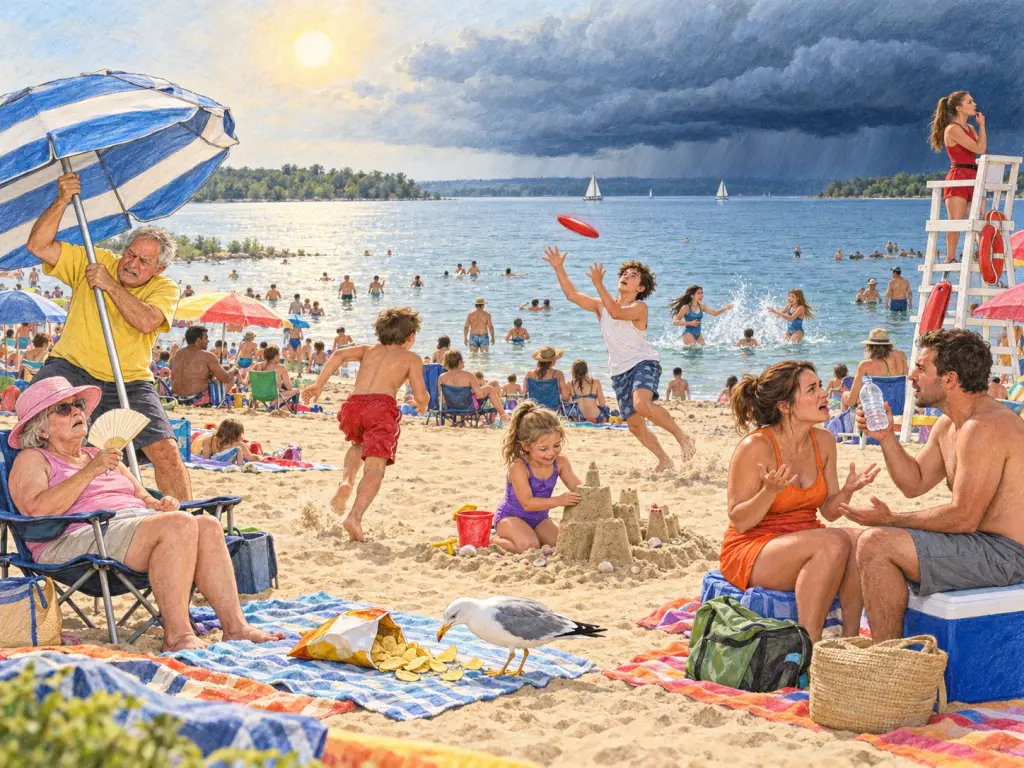
Now think about what is likely to happen at this beach over the next few minutes. Make predictions about several of the people, and explain which details in the scene led you to each one.
Model answers
These are transcripts of a model response, provided for comparison with your own recording.
Level 7 sample answer
128 words
I think a few things will happen soon. First, the seagull is very close to the boy's chips, and the boy is going to the water. So I think the seagull will grab the chips and fly away, and the boy will be sad when he come back. Also, the teenage boy is running backward and he is not looking. I think he will step on the little girl's sandcastle and she will cry. Um, then the man with the yellow T-shirt, his umbrella is moving in the wind, so maybe it will fall down. Finally, there are dark clouds, and the lifeguard is looking at them. I think she will blow her whistle and tell everybody to come out of the water because a storm is coming.
Why this answer is at level 7
This level 7 answer makes several clear predictions and supports them with visible clues. Compared with the higher-level examples, it relies more on repeated sentence patterns, basic descriptions of reactions, and separate incidents, with an occasional grammar slip.
the seagull is very close to the boy's chips, and the boy is going to the water.
— Content/Coherence: The answer clearly establishes why the unattended chips are at risk. This makes the prediction easy to follow, although the overall response proceeds incident by incident. A higher-level answer connects these small events within a developing story about the beach.I think he will step on the little girl's sandcastle and she will cry.
— Vocabulary: The words communicate the likely accident and reaction clearly, but the phrasing is basic. A higher-level answer uses more precise movement words and a wider range of expressions for predicting consequences.the boy will be sad when he come back.
— Listenability: The meaning remains clear, but 'he come back' has a subject–verb agreement error. The higher-level examples maintain more consistent grammatical control while expressing the same kind of future consequence.I think she will blow her whistle and tell everybody to come out of the water because a storm is coming.
— Task Fulfillment: This prediction directly answers the prompt and follows the preceding observations about the clouds and lifeguard. A higher-level response develops the consequences further, such as explaining how the warning will affect the girls playing in the lake.
Level 9 sample answer
171 words
I think this beach is going to get a lot more chaotic in the next few minutes.
First, that boy in red swim trunks has left his chips wide open on his towel, and the seagull's creeping up to the bag. By the time he gets back from the water, I bet half of them will be gone. In the middle, the teenage boy is backpedalling to catch the flying disc without looking behind him, so he'll probably crash into the little girl's sandcastle, and she'll be heartbroken.
On top of that, it's windy — you can tell because the man in the yellow T-shirt can barely keep his umbrella upright. I'd say it'll blow over any second. That also fits with the dark clouds on the horizon. The lifeguard already has her whistle at her lips, so she'll most likely call everyone out of the water before the storm rolls in. As for the couple arguing by the cooler, I imagine one of them will head off to find more water.
Why this answer is at level 9
This level 9 answer combines clear evidence with precise vocabulary, varied prediction language, and conversational transitions. Its incidents support a common theme, but the level 11 example gives them a stronger overall progression by making the approaching storm organize the response.
I think this beach is going to get a lot more chaotic in the next few minutes.
— Content/Coherence: The opening gives the separate predictions a shared theme: increasing chaos. The response then mostly moves between individual incidents. The higher-level example establishes a likely overall outcome and places the smaller incidents within that unfolding sequence.the teenage boy is backpedalling to catch the flying disc without looking behind him
— Vocabulary: The precise verb 'backpedalling' captures the movement that threatens the sandcastle, while the remaining detail explains the risk. The higher-level example sustains similarly precise language while adding more varied conditional phrasing across its predictions.On top of that, it's windy — you can tell because
— Listenability: This conversational transition introduces another prediction and immediately signals that supporting evidence will follow. It helps the listener track the reasoning. A higher-level response can also use transitions to establish timing and connect incidents to the approaching storm.As for the couple arguing by the cooler, I imagine one of them will head off to find more water.
— Task Fulfillment: This adds another relevant prediction, reasonably drawing on the empty bottle and argument. The higher-level example integrates the couple's likely departure into the weather storyline, giving their prediction a clearer connection to the response's overall outcome.
Level 11 sample answer
177 words
Given everything going on, I'd expect this beach to empty out fairly quickly.
The most obvious clue is on the horizon: those dark clouds are building, and the lifeguard's frowning at them with her whistle at her lips. Unless they drift off, she'll almost certainly call everyone in, so the two girls splashing around will have to cut their fun short.
Before that happens, there'll be a couple of smaller dramas. The seagull creeping toward that unattended bag of chips is going to help itself, and the boy in red will come back to find his snack scattered across his towel. Meanwhile, the teenager backpedalling for the flying disc isn't watching where he's going, so I suspect that little girl's sandcastle is about to be flattened, which will probably end in tears.
As for the man in yellow, if the wind keeps tilting his umbrella like that, it'll be cartwheeling down the beach before he can anchor it. And the couple arguing by the cooler will likely pack up and leave the moment the first raindrops fall.
Why this answer is at level 11
This level 11 answer organizes the beach's likely evacuation and smaller mishaps into a coherent sequence. Precise vocabulary, controlled complex sentences, and qualified predictions make the explanation detailed and natural, while consequences remain connected to the people and clues in the scene.
Before that happens, there'll be a couple of smaller dramas.
— Content/Coherence: This transition places the snack theft and sandcastle accident before the expected evacuation. It gives the response a timeline and connects the smaller incidents to the main prediction, creating stronger organization than a simple list.it'll be cartwheeling down the beach before he can anchor it.
— Vocabulary: The verbs 'cartwheeling' and 'anchor' vividly describe the umbrella's possible movement and the man's attempt to secure it. The surrounding condition about continuing wind keeps this dramatic prediction tied to an observed clue.Unless they drift off, she'll almost certainly call everyone in
— Listenability: The opening condition qualifies the prediction before stating the likely action. The clause structure makes the relationship between the clouds and the lifeguard's response easy to follow, while showing grammatical flexibility.so the two girls splashing around will have to cut their fun short.
— Task Fulfillment: The answer follows the weather prediction through to its effect on specific swimmers. This develops a connected consequence for people in the scene and explains how the lifeguard's likely action will change what they are doing.
What moves an answer from 7 to 9 to 11
These are model answers written to show each level. The labels are practice estimates, not examiner scores.
Connect each prediction to visible evidence. Explain plausible next events and use language of likelihood instead of presenting guesses as facts.
- Content/Coherence: Level 7 models communicate the main ideas; level 9 models develop relevant details with clear connections; level 11 models sustain precise, well-integrated development.
- Vocabulary: Compare adequate everyday wording with more varied, accurate choices at level 9 and flexible, precise expression at level 11.
- Listenability: Higher-level delivery needs clear pronunciation, rhythm, intonation and controlled pauses. Transcripts suggest phrasing and organisation, but cannot demonstrate these audio features; a recording is needed.
- Task Fulfillment: Compare how fully the response addresses the request, develops enough relevant detail and maintains an appropriate tone for the audience within the task limits.
Assess the criteria together. A longer answer or rarer words alone do not establish a higher level.
Answer this question and get your level
More Task 4 questions
- Sandbag station during spring flooding
- Windy cul-de-sac before the first snow
- Community garden on harvest day
- Pancake breakfast fundraiser in a community hall
- Charity car wash in a parking lot
- Park tree-planting day on a windy morning
All speaking Task 4 sample questions · Read the Task 4 guide