CELPIP® Speaking Task 4 sample: Community Kitchen for Healthy Lunches
Making Predictions · Preparation: 30 seconds · Response: 60 seconds · Published
Original practice questions in CELPIP® task formats, created independently by CELPIP Study.
Practice question
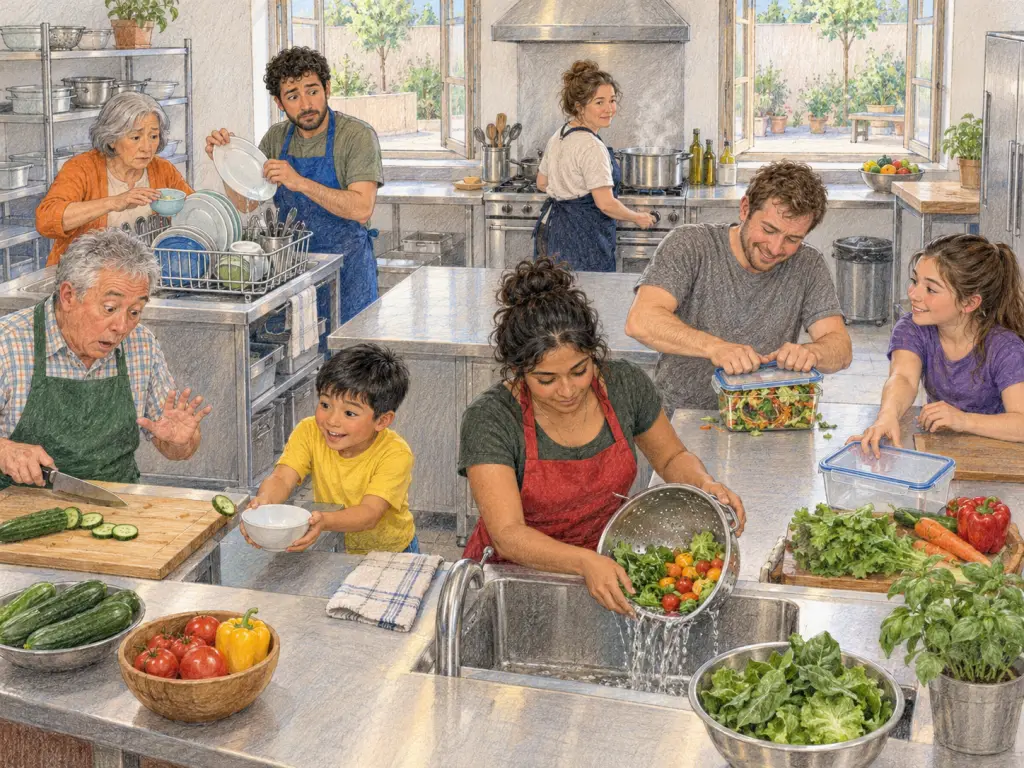
Explain the most probable developments in this kitchen during the next few minutes. Give reasons based on what people are doing and how objects are positioned. Preparation: 30 seconds. Response: 60 seconds.
Model answers
These are transcripts of a model response, provided for comparison with your own recording.
Level 7 sample answer
125 words
I think the cucumber slice will roll into the boy's bowl because he's holding it right under the cutting board's edge. The older man will probably look relieved. On the right, the girl will likely offer a bigger containers to the man because his lunch container is too full to close. He can move his food into it. Um, the instructor may turn the stove down because the pot is steaming and her hand is near the knob. The woman in red will finish draining the vegetables. At the drying rack, the older woman will probably steady the small bowl before it moves. The man holding the wet plate will need to wait because there isn't much space in rack. They may rearrange things together.
Why this answer is at level 7
This answer makes relevant predictions and supports them with clear physical clues. Compared with the higher models, its organization feels more like a list, its wording is less accurate, and some developments receive little explanation.
I think the cucumber slice will roll into the boy's bowl because he's holding it right under the cutting board's edge.
— Content/Coherence: The prediction follows logically from the bowl's position. The higher models develop this interaction further by explaining why the older man can pause or avoid intervening.the girl will likely offer a bigger containers to the man
— Listenability: The meaning is clear, but 'a bigger containers' has a singular and plural mismatch. The higher models use accurate wording such as 'the larger container' and describe the transfer more precisely.The woman in red will finish draining the vegetables.
— Listenability: This short sentence is easy to follow, but its abrupt placement between the stove and drying rack contributes to a list-like rhythm. The higher models use transitions to connect these shifts more smoothly.The man holding the wet plate will need to wait because there isn't much space in rack.
— Task Fulfillment: This directly predicts what happens next using the crowded rack as evidence. The higher models explain the sequence more fully: secure the perched bowl and create space before adding the plate.
Level 9 sample answer
154 words
The boy seems likely to catch the cucumber slice in his bowl. It's rolling toward the cutting board's edge, and he's already positioned the bowl directly underneath, so the older man may not need to intervene. Over on the right, the teenager will probably pass the larger container to the man who's struggling with his lunch. Transferring some or all of the food should let him close a lid properly. At the stove, the instructor may lower the heat, since she's watching the steaming pot with her hand poised at the knob. The drying rack presents a different challenge. Before the man adds his wet plate, the older woman will probably stabilize or reposition the small bowl perched on it. They'll need to make room rather than squeeze the plate straight in. Meanwhile, the woman at the sink should finish draining her vegetables, bringing that part of the preparation a step closer to completion.
Why this answer is at level 9
This answer connects predictions, evidence, and practical consequences more smoothly than the level 7 model, with stronger sequencing and more precise verbs. Compared with the level 11 model, some references remain broad, and it develops people's intentions less fully.
Before the man adds his wet plate, the older woman will probably stabilize or reposition the small bowl perched on it.
— Content/Coherence: Using 'Before' establishes a sensible sequence instead of listing separate actions. The higher model develops the cooperation further by explaining how the man might help rearrange the rack.Transferring some or all of the food should let him close a lid properly.
— Vocabulary: The transfer is described clearly, but 'a lid' leaves the container reference broad. The higher model identifies the replacement and explains that it can close without compressing the food.The drying rack presents a different challenge.
— Listenability: This transition helps a listener follow the move from the stove to the drying area. The higher model makes the transition more informative by immediately identifying cooperation as the next requirement.It's rolling toward the cutting board's edge, and he's already positioned the bowl directly underneath, so the older man may not need to intervene.
— Task Fulfillment: The answer links movement and positioning to a likely consequence for another person. The higher model also uses the boy's eager expression to explain his anticipation, adding another relevant layer of evidence.
Level 11 sample answer
171 words
The most immediate outcome will probably be the cucumber slice dropping into the boy's bowl. Its position beneath the board's edge looks deliberate, and his eager expression suggests he's anticipating exactly that. The older man may simply pause until the slice has been caught. On the right, the teenager is likely to offer the larger container to the man whose lunch will not fit under its lid. Once the contents are transferred, he should be able to close the replacement without compressing everything. At the stove, the instructor may adjust the heat downward: the pot is steaming, and her hand is already poised at the control. The drying area will probably require cooperation before another item can be added. The older woman should secure the perched bowl, while the man holding the wet plate waits for space or helps rearrange the rack. Meanwhile, the woman in red will likely finish draining the vegetables. Within a few minutes, several preparations should be complete, provided the crowded drying rack is dealt with first.
Why this answer is at level 11
This answer combines detailed visual evidence with clear predictions about intentions, cooperation, and practical outcomes. Precise vocabulary, purposeful sequencing, and measured uncertainty make its explanation more developed and cohesive than the other models.
The older woman should secure the perched bowl, while the man holding the wet plate waits for space or helps rearrange the rack.
— Content/Coherence: The sentence coordinates both people's actions around the same obstacle. It explains how securing the bowl, waiting, and rearranging the rack fit together as a plausible development.Once the contents are transferred, he should be able to close the replacement without compressing everything.
— Vocabulary: Words such as 'contents,' 'replacement,' and 'compressing' describe the container problem precisely. The wording explains both the solution and its practical benefit without unnecessary technical language.The most immediate outcome will probably be the cucumber slice dropping into the boy's bowl.
— Listenability: The opening gives the listener a clear priority and a concrete event to picture. 'Most immediate' establishes timing, while 'probably' keeps the prediction appropriately tentative.his eager expression suggests he's anticipating exactly that.
— Task Fulfillment: The answer uses the boy's expression as evidence of intention, supplementing the bowl's physical position. This makes the prediction more fully grounded in the scene than relying on object placement alone.
What moves an answer from 7 to 9 to 11
These are model answers written to show each level. The labels are practice estimates, not examiner scores.
Connect each prediction to visible evidence. Explain plausible next events and use language of likelihood instead of presenting guesses as facts.
- Content/Coherence: Level 7 models communicate the main ideas; level 9 models develop relevant details with clear connections; level 11 models sustain precise, well-integrated development.
- Vocabulary: Compare adequate everyday wording with more varied, accurate choices at level 9 and flexible, precise expression at level 11.
- Listenability: Higher-level delivery needs clear pronunciation, rhythm, intonation and controlled pauses. Transcripts suggest phrasing and organisation, but cannot demonstrate these audio features; a recording is needed.
- Task Fulfillment: Compare how fully the response addresses the request, develops enough relevant detail and maintains an appropriate tone for the audience within the task limits.
Assess the criteria together. A longer answer or rarer words alone do not establish a higher level.
Answer this question and get your level
More Task 4 questions
- Neighbourhood driveway sale
- Garden centre checkout aisle
- Clothing store returns counter
- Winter craft market purchases
- Birthday Picnic at a Park Shelter
- Apartment Courtyard on Moving Day
All speaking Task 4 sample questions · Read the Task 4 guide